Saturday, February 23, 2008

Study: Kids' TV, computer habits start early

(CNN) -- Pre-schoolers are likely to spend as much time in front of the television or computer as they are playing outside, three times longer than the time spent reading, according to a new study that looks at the media's pervasiveness even among the very young.

Children aged 6 and under spend an average of two hours a day playing video games, using computers, and watching TV and videos, about the same amount spent on outdoor activities, the Kaiser Family Foundation reports in a study released Tuesday. That amount is about three times the average 49 minutes spent reading or being read to.

"We found out that kids today are growing up absolutely immersed in electronic media in this country, starting at the youngest ages," says Kaiser's Vicky Rideout, lead author of the study. "[At] even just a few months old, they're watching TV, watching videos, using computers, playing video games."

The study found that even the youngest of children are no exception. Nearly two-thirds of kids under 2 spend a couple of hours a day in front of the screen. (The American Academy of Pediatrics has recommended that children under 2 not watch TV at all.)

"We know this is an absolutely critical period for children's development -- for their intellectual development, their social development, their physical development," says Rideout. "But we need to make sure the media that they are using are not only not harming that development, but are actually enhancing it."

TV also affects children's reading abilities. Kids with a screen in their bedroom or who live in "heavy" households -- defined as a home where the TV is on "always" or "most of the time" -- are less likely to be able to read by age 6. The study found 34 percent of 4- to 6-year-olds from "heavy" households could read, while 56 percent of other children that age could.

But the study said despite the influx of media, reading is still a part of young children's lives. Nearly 8 in 10 will read or be read to on a typical day, on average for about 49 minutes, compared to the hours in front of TVs and computers.

Kaiser researchers based their study on a telephone survey of more than 1,000 parents of children ages 6 months through 6 years.

Among the other findings of the Kaiser study:

• More than a third of kids under 6 have a TV in their bedroom.

• About one in four have a VCR or DVD where they sleep.

• A computer is present in 7 percent of the bedrooms.

• On an average day, about a quarter of 4- to 6-year-olds spend more than an hour on a computer.

Researchers say that the findings should raise concerns on the importance of the early years on children's development, and that using TV and videos might displace more interactive and constructive time for learning.

Studies in the past have linked prolonged TV viewing to obesity in children, poor sleep patterns, and later adult violence. And as younger watchers become more prevalent, Kaiser's Rideout says that more research is needed to understand the impact of early TV viewing.

To keep any TV watching to a healthy level, the American Academy of Pediatrics and the American Psychological Association say parents should set time limits to how much and what children can watch. They also recommend choosing programs carefully and helping kids find other options, such as learning a sport or musical instrument.

"I would suggest that parents want to probably take a look at how much time their kids are spending with media and how much time their kids are spending in other activities," Rideout says.

"[Parents should] consider if they really want to have a TV in their 3-year-old's bedroom or not ... and think about maybe turning off the TV in the home if nobody's watching it."

CNN medical producer Christy Feig contributed to this report.


____________________________________________________________________________

I think that this is very worrying. The average American life for both men and women has gone down for the fist time in decades. I think that kids habitually sitting in front of computer games and television can be party to blame. These traits are carried on through life, and a when someone takes a job that requires sitting at a desk from nine to five can be very bad for you health. These habits are started at an early age and we aren't doing enough to prevent it.

*VERB: It's what you do!*

pic.

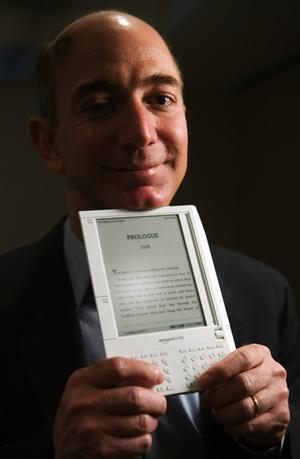
The new Amazon Kindle. Currently sold out.

New Shiny Amazon doesn't replace my old book

Now that people are finally getting their Amazon Kindles in the mail (in addition to other such devices, like the Sony Reader), it's time to reassess whether they should actually want them. Sure, they're the hippest reading devices this side of Teddy Ruxpin, but are we really ready to hurl books out of the window to completely embrace sterile digitalization?

It would be easy to put a hippie spin on the whole situation. Kindle is saving the trees! But I, for one, hate trees. Or rather, I think their sacrifice is for a worthy cause. At the risk of sounding like an old fogey, I'm going to say that it's nice to hold a book, bend the pages and smell the darn thing. Books have a great aesthetic quality that the Kindle is never going to match. What's it going to do, show different fonts?

"So what?" naysayers will ask. The Kindle sold out over the holiday season, so people are clearly willing to give up the look and feel of a book in favor of a sleek new doohickey. Not to mention that a 10.3-ounce, 0.7-inch deep unit is a bit easier to lug around than the 200 titles it can hold.

But the Kindle has more flaws than meets the eye.

Just as iTunes has crippled the record industry, if the Kindle and digital books catch on, book stores may be next on the chopping block. Presumably, the consumer stands to benefit in this case, as Kindle provides standardized prices, a huge range of titles that will never sell out and utmost convenience.

Yet economics may still have something to say about Amazon's book-killer. If it catches on, mom-and-pop bookstores are ruined, decreasing competition in general and allowing Amazon to all but monopolize the e-book market. We would soon all bend to the totalitarian regime of electronic books and the Kindle's wireless delivery system; every man, woman and child would become a mindless drone wasting away while new issues of The New York Times roll onto the beautiful 6-inch display.

Still, for now, the product doesn't really have the specifications for prime time. It lacks a color display, which limits the capacity for newspaper and blog reading, supposedly major features that seem as though they can be nothing but underutilized. If there's going to be a digital book-reading device, why exclude almost anything that has illustrations? A "Kindle 2" is probably pretty much inevitable, so why release the lesser version to begin with?

Plus, it costs $400 and each book costs $10. I doubt there's really anyone that needs to have 200 books on call at any given time, so the whole thing doesn't really make a lot of economic sense to begin with, especially since used books are generally far cheaper than $10 anyway. It makes sense for an iPod to be able to store zillions of songs because who knows what they're going to want to listen to moment to moment? But it's a pretty slim demographic that gets halfway through a Toni Morrison novel and suddenly gets the craving to switch over to William Burroughs. And, well, if there are people who belong to that elusive group, they can probably manage to have two books on hand as opposed to an unrealistically expensive electronic device.

But the device has one upside: It makes legitimate self-publishing far more attainable.

Amazon allows anyone to upload writing and charge money for it, eliminating the whole nightmare of publishing companies and agents. While I doubt the latest Damon Beres novel is going to rival Stephen King, this function will, at the very least, challenge book publishers in much the same way that blogs challenge magazines and newspapers. Of course, e-books could exist without the Kindle anyway, but it's a nice idea.

As of now, the Kindle is still sold out on Amazon. It's a tempting idea for a number of reasons, but consumers should look at the big picture. The convenience isn't worth it, and there are a host of problems to consider. In the end, it'd be like replacing movie theaters with YouTube - it just doesn't make sense.


__________________________________
The above was an Opinion article in the Washington Square News (online.) The issue is dated 02/20/08 and was written by Damon Beres.


This is a very enlightened article. The arguments for the Kindle sound just like the original arguments for the iPod. Is this the next iPod? No one can know, but because Amazon is sold out of the Kindle currently, this is a ignorable sign. The demand is clearly there. Will students one day have their school textbooks given to them through the Kindle? My guess is yes, we, they, and everyone after will.